Feature significance for kernel density estimation
featureSignif.RdIdentify significant features of kernel density estimates of 1- to 4-dimensional data.
Usage
featureSignif(x, bw, gridsize, scaleData=FALSE, addSignifGrad=TRUE,
   addSignifCurv=TRUE, signifLevel=0.05)
Arguments
- x
data matrix
- bw
vector of bandwidth(s)
- gridsize
vector of estimation grid sizes
- scaleData
flag for scaling the data i.e. transforming to unit variance for each dimension.
- addSignifGrad
flag for computing significant gradient regions
- addSignifCurv
flag for computing significant curvature regions
- signifLevel
significance level
Value
Returns an object of class fs which is a list with the following fields
- x
data matrix
- names
name labels used for plotting
- bw
vector of bandwidths
- fhat
kernel density estimate on a grid
- grad
logical grid for significant gradient
- curv
logical grid for significant curvature
- gradData
logical vector for significant gradient data points
- gradDataPoints
significant gradient data points
- curvData
logical vector for significant curvature data points
- curvDataPoints
significant curvature data points
Details
Feature significance is based on significance testing of the gradient (first derivative) and curvature (second derivative) of a kernel density estimate. This was developed for 1-d data by Chaudhuri & Marron (1995), for 2-d data by Godtliebsen, Marron & Chaudhuri (1999), and for 3-d and 4-d data by Duong, Cowling, Koch & Wand (2007).
The test statistic for gradient testing is at a point \(\mathbf{x}\) is $$W(\mathbf{x}) = \Vert \widehat{\nabla f} (\mathbf{x}; \mathbf{H}) \Vert^2$$ where \(\widehat{\nabla f} (\mathbf{x};\mathbf{H})\) is kernel estimate of the gradient of \(f(\mathbf{x})\) with bandwidth \(\mathbf{H}\), and \(\Vert\cdot\Vert\) is the Euclidean norm. \(W(\mathbf{x})\) is approximately chi-squared distributed with \(d\) degrees of freedom where \(d\) is the dimension of the data.
The analogous test statistic for the curvature is $$W^{(2)}(\mathbf{x}) = \Vert \mathrm{vech} \widehat{\nabla^{(2)}f} (\mathbf{x}; \mathbf{H})\Vert ^2$$ where \(\widehat{\nabla^{(2)} f} (\mathbf{x};\mathbf{H})\) is the kernel estimate of the curvature of \(f(\mathbf{x})\), and vech is the vector-half operator. \(W^{(2)}(\mathbf{x})\) is approximately chi-squared distributed with \(d(d+1)/2\) degrees of freedom.
Since this is a situation with many dependent hypothesis tests, we use the Hochberg multiple comparison testing procedure to control the overall level of significance. See Hochberg (1988) and Duong, Cowling, Koch & Wand (2007).
References
Chaudhuri, P. & Marron, J.S. (1999) SiZer for exploration of structures in curves. Journal of the American Statistical Association 94, 807–823.
Duong, T., Cowling, A., Koch, I. & Wand, M.P. (2008) Feature significance for multivariate kernel density estimation. Computational Statistics and Data Analysis 52, 4225–4242.
Hochberg, Y. (1988) A sharper Bonferroni procedure for multiple tests of significance. Biometrika 75, 800–802.
Godtliebsen, F., Marron, J.S. & Chaudhuri, P. (2002) Significance in scale space for bivariate density estimation. Journal of Computational and Graphical Statistics 11, 1–22.
Wand, M.P. & Jones, M.C. (1995) Kernel Smoothing. Chapman & Hall/CRC, London.
Examples
## Univariate example
data(earthquake)
eq3 <- -log(-earthquake[,3])
fs <- featureSignif(eq3, bw=0.1)
plot(fs, addSignifGradRegion=TRUE)
 ## Bivariate example
data(geyser, package="MASS")
fs <- featureSignif(geyser)
plot(fs, addKDE=FALSE, addData=TRUE) ## data only
## Bivariate example
data(geyser, package="MASS")
fs <- featureSignif(geyser)
plot(fs, addKDE=FALSE, addData=TRUE) ## data only
 plot(fs, addKDE=TRUE) ## KDE plot only
plot(fs, addSignifGradRegion=TRUE)
plot(fs, addKDE=TRUE) ## KDE plot only
plot(fs, addSignifGradRegion=TRUE)
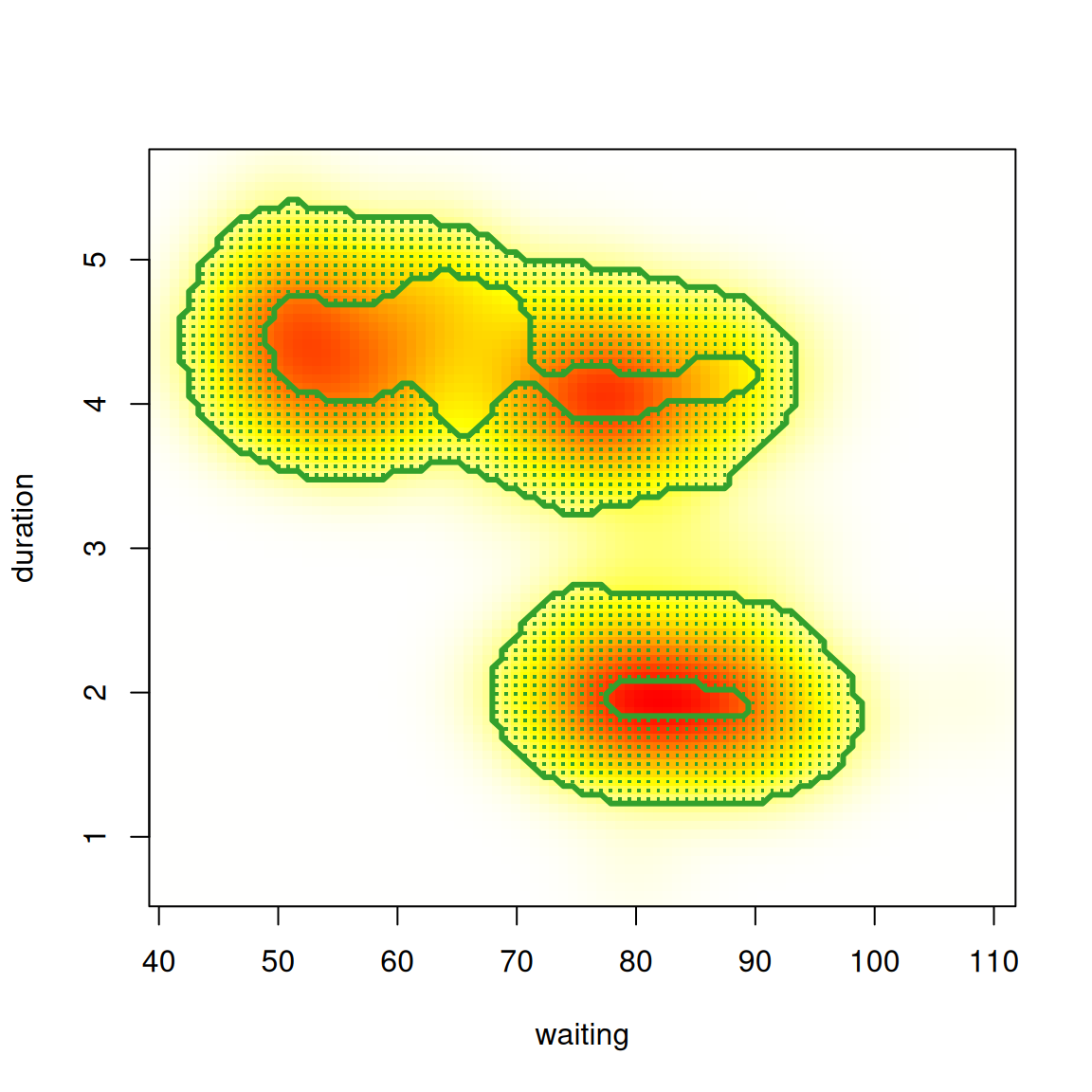 plot(fs, addKDE=FALSE, addSignifCurvRegion=TRUE)
 plot(fs, addSignifCurvData=TRUE, curvCol="cyan")
