Kernel density estimate
kde.RdKernel density estimate for 1- to 6-dimensional data.
Usage
kde(x, H, h, gridsize, gridtype, xmin, xmax, supp=3.7, eval.points, binned,
    bgridsize, positive=FALSE, adj.positive, w, compute.cont=TRUE,
    approx.cont=TRUE, unit.interval=FALSE, density=FALSE, verbose=FALSE)

# S3 method for class 'kde'
predict(object, ..., x, zero.flag=TRUE)
Arguments
- x
matrix of data values
- H,h
bandwidth matrix/scalar bandwidth. If these are missing,
Hpiorhpiis called by default.- gridsize
vector of number of grid points
- gridtype
not yet implemented
- xmin,xmax
vector of minimum/maximum values for grid
- supp
effective support for standard normal
- eval.points
vector or matrix of points at which estimate is evaluated
- binned
flag for binned estimation.
- bgridsize
vector of binning grid sizes
- positive
flag if data are positive (1-d, 2-d). Default is FALSE.
- adj.positive
adjustment applied to positive 1-d data
- w
vector of weights. Default is a vector of all ones.
- compute.cont
flag for computing 1% to 99% probability contour levels. Default is TRUE.
- approx.cont
flag for computing approximate probability contour levels. Default is TRUE.
- unit.interval
flag for computing log transformation KDE on 1-d data bounded on unit interval [0,1]. Default is FALSE.
- density
flag if density estimate values are forced to be non-negative function. Default is FALSE.
- verbose
flag to print out progress information. Default is FALSE.
- object
object of class
kde- zero.flag
deprecated (retained for backwards compatibilty)
- ...
other parameters
Value
A kernel density estimate is an object of class kde which is a
list with fields:
- x
data points - same as input
- eval.points
vector or list of points at which the estimate is evaluated
- estimate
density estimate at
eval.points- h
scalar bandwidth (1-d only)
- H
bandwidth matrix
- gridtype
"linear"
- gridded
flag for estimation on a grid
- binned
flag for binned estimation
- names
variable names
- w
vector of weights
- cont
vector of probability contour levels
Details
For d=1, if h is missing, the default bandwidth is hpi.
For d>1, if H is missing, the default is Hpi.
For d=1, if positive=TRUE then x is transformed to
log(x+adj.positive) where the default adj.positive is
the minimum of x. This is known as a log transformation density
estimate. If unit.interval=TRUE then x is transformed to
qnorm(x). See kde.boundary for boundary kernel density estimates, as these tend to be more robust than transformation density estimates.
For d=1, 2, 3, and if eval.points is not specified, then the
density estimate is computed over a grid
defined by gridsize (if binned=FALSE) or
by bgridsize (if binned=TRUE). This form is suitable for
visualisation in conjunction with the plot method.
For d=4, 5, 6, and if eval.points is not specified, then the
density estimate is computed over a grid defined by gridsize.
If eval.points is specified, as a vector (d=1) or
as a matrix (d=2, 3, 4), then the density estimate is computed at
eval.points. This form is suitable for numerical summaries
(e.g. maximum likelihood), and is not compatible with the plot
method. Despite that the density estimate is returned only at
eval.points, by default, a binned gridded estimate is
calculated first and then the density estimate at eval.points
is computed using the predict method. If this default intermediate
binned grid estimate is not required, then set binned=FALSE to
compute directly the exact density estimate at eval.points.
Binned kernel estimation is an approximation to the exact kernel
estimation and is available for d=1, 2, 3, 4. This makes
kernel estimators feasible for large samples. The default value of the
binning flag binned is n>1 (d=1), n>500 (d=2), n>1000 (d>=3).
Some times binned estimation leads to negative density values: if non-negative
values are required, then set density=TRUE.
The default bgridsize,gridsize are d=1: 401; d=2: rep(151, 2); d=3:
rep(51, 3); d=4: rep(21, 4).
The effective support for a normal kernel is where
all values outside [-supp,supp]^d are zero.
The default xmin is min(x)-Hmax*supp and xmax
is max(x)+Hmax*supp where Hmax is the maximum of the
diagonal elements of H. The grid produced is the outer
product of c(xmin[1], xmax[1]), ..., c(xmin[d], xmax[d]).
For ks \(\geq\) 1.14.0, when binned=TRUE and xmin,xmax
are not missing, the data values x are clipped to the estimation grid
delimited by xmin,xmax to prevent potential memory leaks.
Examples
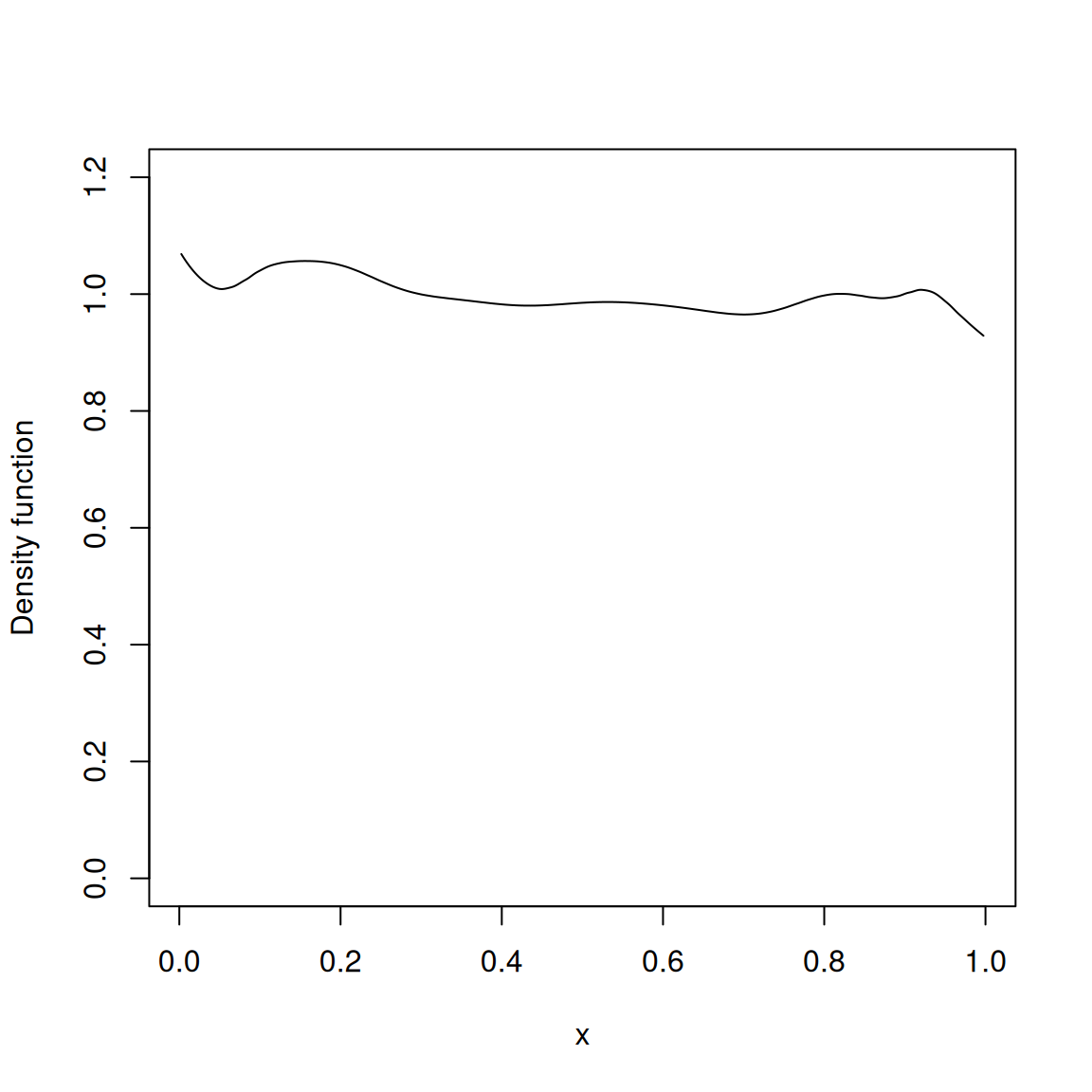
## unit interval data
set.seed(8192)
fhat <- kde(runif(10000,0,1), unit.interval=TRUE)
plot(fhat, ylim=c(0,1.2))
 ## positive data
data(worldbank)
wb <- as.matrix(na.omit(worldbank[,2:3]))
wb[,2] <- wb[,2]/1000
fhat <- kde(x=wb)
fhat.trans <- kde(x=wb, adj.positive=c(0,0), positive=TRUE)
plot(fhat, col=1, xlim=c(0,20), ylim=c(0,80))
plot(fhat.trans, add=TRUE, col=2)
rect(0,0,100,100, lty=2)
## positive data
data(worldbank)
wb <- as.matrix(na.omit(worldbank[,2:3]))
wb[,2] <- wb[,2]/1000
fhat <- kde(x=wb)
fhat.trans <- kde(x=wb, adj.positive=c(0,0), positive=TRUE)
plot(fhat, col=1, xlim=c(0,20), ylim=c(0,80))
plot(fhat.trans, add=TRUE, col=2)
rect(0,0,100,100, lty=2)
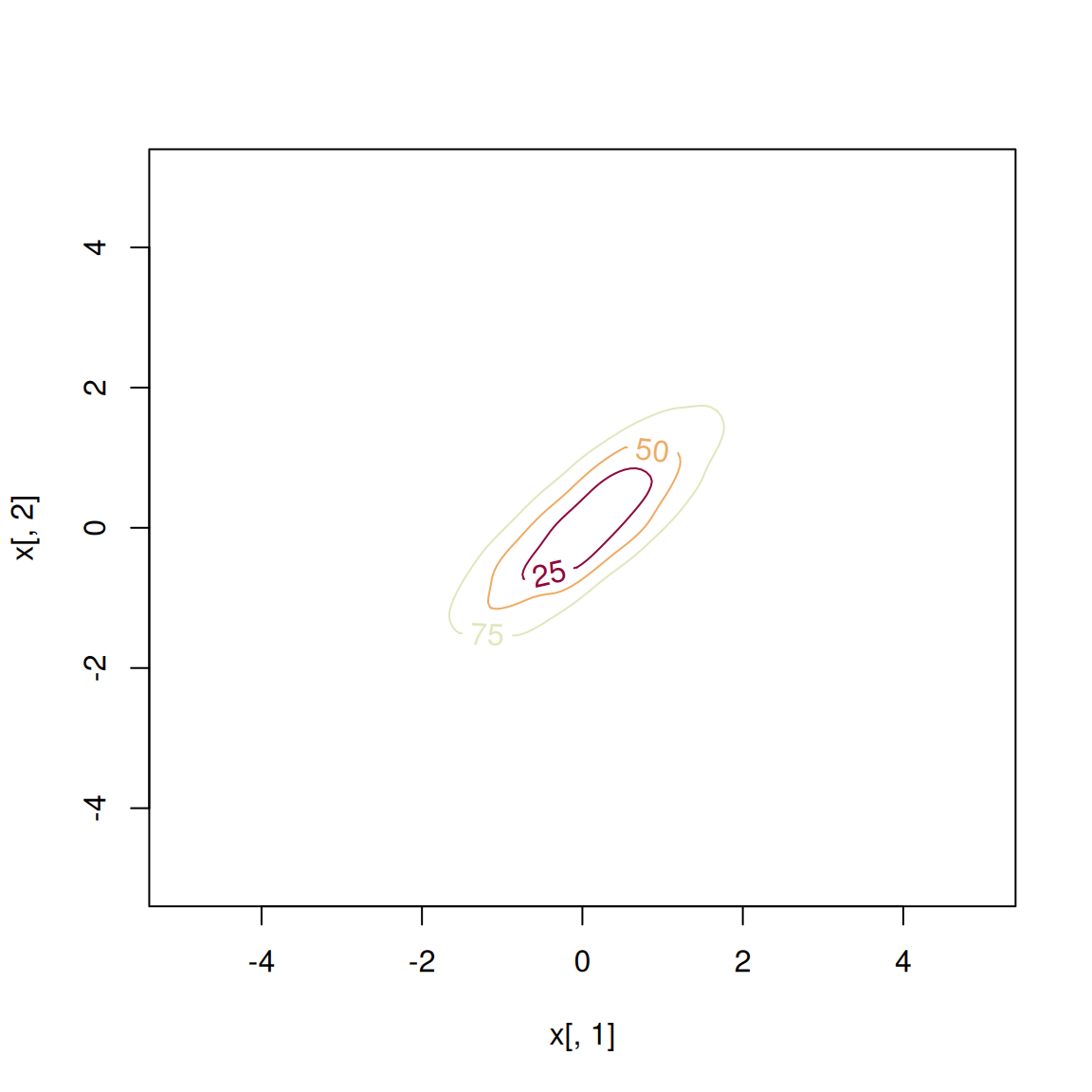
 ## large data on non-default grid
## 151 x 151 grid = [-5,-4.933,..,5] x [-5,-4.933,..,5]
set.seed(8192)
x <- rmvnorm.mixt(10000, mus=c(0,0), Sigmas=invvech(c(1,0.8,1)))
fhat <- kde(x=x, compute.cont=TRUE, xmin=c(-5,-5), xmax=c(5,5), bgridsize=c(151,151))
plot(fhat)
## large data on non-default grid
## 151 x 151 grid = [-5,-4.933,..,5] x [-5,-4.933,..,5]
set.seed(8192)
x <- rmvnorm.mixt(10000, mus=c(0,0), Sigmas=invvech(c(1,0.8,1)))
fhat <- kde(x=x, compute.cont=TRUE, xmin=c(-5,-5), xmax=c(5,5), bgridsize=c(151,151))
plot(fhat)
 ## See other examples in ? plot.kde