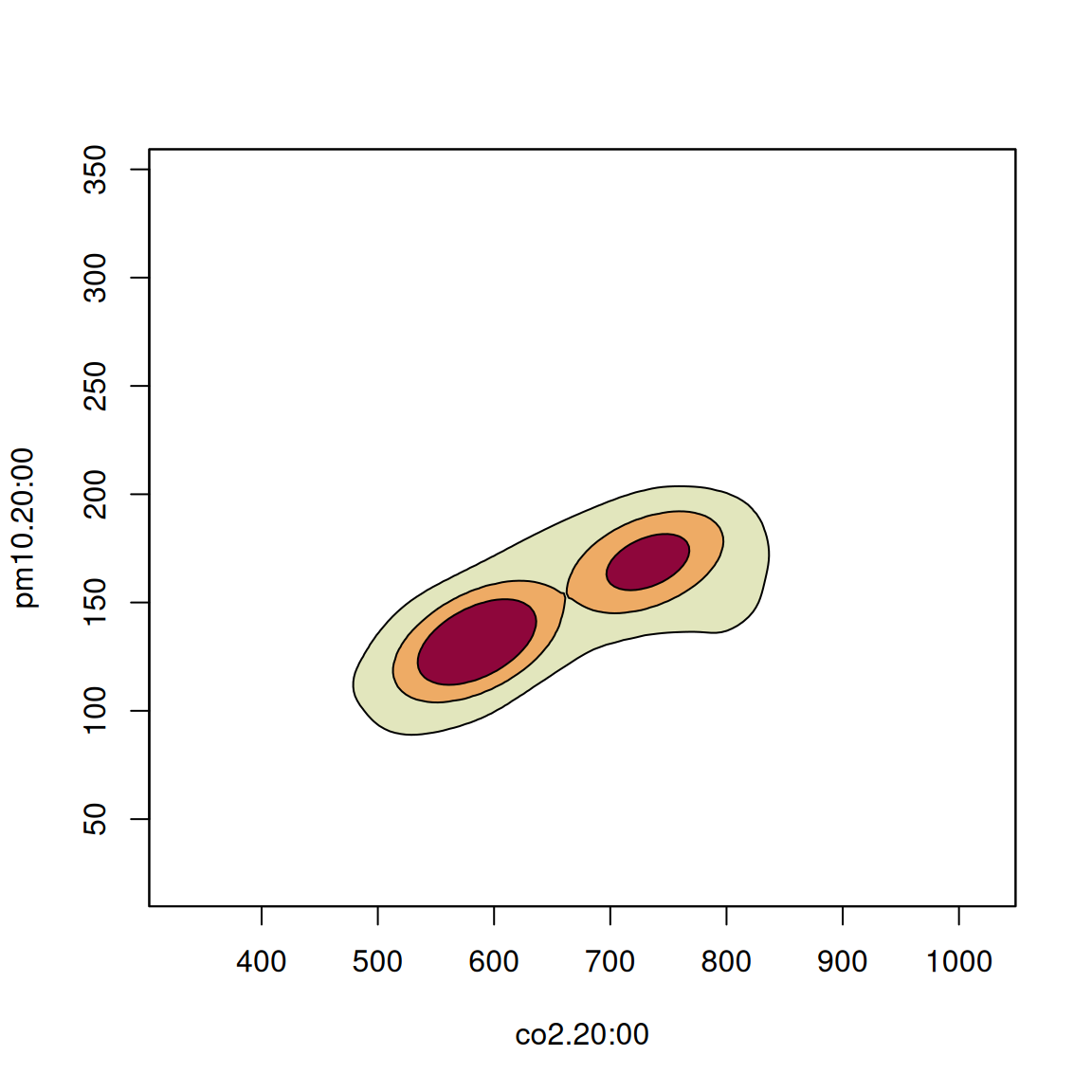
Deconvolution kernel density derivative estimate
kdcde.RdDeconvolution kernel density derivative estimate for 1- to 6-dimensional data.
Arguments
- x
matrix of data values
- H,h
bandwidth matrix/scalar bandwidth. If these are missing,
Hpiorhpiis called by default.- Sigma,sigma
error variance matrix
- reg
regularisation parameter
- gridsize
vector of number of grid points
- binned
flag for binned estimation
- bgridsize
vector of binning grid sizes
- verbose
flag to print out progress information. Default is FALSE.
- ...
other parameters to
kde
Value
A deconvolution kernel density derivative estimate is an object of class
kde which is a list with fields:
- x
data points - same as input
- eval.points
vector or list of points at which the estimate is evaluated
- estimate
density estimate at
eval.points- h
scalar bandwidth (1-d only)
- H
bandwidth matrix
- gridtype
"linear"
- gridded
flag for estimation on a grid
- binned
flag for binned estimation
- names
variable names
- w
vector of weights
- cont
vector of probability contour levels
Details
A weighted kernel density estimate is utilised to perform the
deconvolution. The weights w are the solution to a
quadratic programming problem, and then input into kde(w=w).
This weighted estimate also requires an estimate of the error
variance matrix from repeated observations, and of the regularisation
parameter. If the latter is missing, it is calculated internally using
a 5-fold cross validation method. See Hazelton & Turlach (2009).
dckde is an alias for kdcde.
If the bandwidth H is missing from kde, then
the default bandwidth is the plug-in selector
Hpi. Likewise for missing h.
The effective support, binning, grid size, grid range, positive
parameters are the same as kde.
References
Hazelton, M. L. & Turlach, B. A. (2009) Nonparametric density deconvolution by weighted kernel density estimators, Statistics and Computing 19, 217–228.
Examples
data(air)
air <- air[, c("date", "time", "co2", "pm10")]
air2 <- reshape(air, idvar="date", timevar="time", direction="wide")
air <- as.matrix(na.omit(air2[,c("co2.20:00", "pm10.20:00")]))
Sigma.air <- diag(c(var(air2[,"co2.19:00"] - air2["co2.21:00"], na.rm=TRUE),
   var(air2[,"pm10.19:00"] - air2[,"pm10.21:00"], na.rm=TRUE)))
fhat.air.dec <- kdcde(x=air, Sigma=Sigma.air, reg=0.00021, verbose=TRUE)
#> ================================================================================
plot(fhat.air.dec, drawlabels=FALSE, display="filled.contour", lwd=1)